

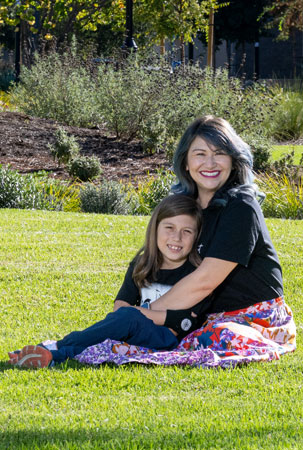
When LeAnn lost her job in the summer of 2023, it wasn’t just a career setback. It was the moment that would push her to return to college after more than two decades. She had worked her way into a strong position in quality assurance at a biopharma company, making enough money to think about buying a home for her and her 8-year-old son. But when the company downsized, cutting 90% of its U.S. workforce, her plans and her stability were gone.
“I only had a high school diploma,” she said. “Even though I had all this experience, my education wasn’t enough to get me past the screening process for new jobs. I couldn’t even land one interview.”
Faced with unemployment and the responsibility of raising her son on her own, LeAnn began to consider options she had long put off. She quickly realized that going back to school could give her the structure, qualifications, and opportunity she needed to rebuild her life. “I did some backwards planning,” she explained. “I found that [California State University] Dominguez Hills offers a Bachelor of Science in Quality Assurance. I thought, ‘If I can earn that, I can double my income and get back on my feet.’”
The next step was figuring out how to get there. LeAnn had taken classes at Golden West and Orange Coast College more than a decade earlier, and during her research, she discovered Golden West worked closely with CSU Dominguez Hills. That, along with the College’s strong science programs, made the decision feel right.
With support from her counselor, LeAnn created a two-year plan that included transferable coursework, general education and several certificates she could stack onto her resume along the way. While the academic roadmap gave her a sense of direction, her financial reality remained uncertain. By January 2024, her unemployment benefits ran out. That’s when she turned to CalWORKs, a decision that changed the course of her college experience. “I was approved within a month, and I was so thankful,” she recalled. “They offered textbook support, parking permits, paid student fees, and I received CalFresh, which made a huge difference feeding my son and me.”
What began as simple financial assistance quickly became something much deeper for LeAnn: a sense of stability and belonging in a life marked by trauma and instability. She shared, “I’ve faced some heavy generational trauma. Living with relatives struggling with alcoholism and drug use creates so much noise. It’s hard to find peace in that kind of environment.” CalWORKs provided more than just resources — it offered a safe space to process life’s challenges. “Being able to talk to my counselor, not just about academics, but about life, gave me peace.”
That support was vital as LeAnn balanced the demands of parenting and full-time coursework. CalWORKs helped by providing childcare assistance and connecting her to affordable after-school programs, easing the strain of being away from her son during evening labs. She opened up about moments of embarrassment, especially when her son would cry or draw attention. But through CalWORKs, she found not just practical help, but a community that embraced student-parents. “The simple fact that the campus has the program, a dedicated area, and staff makes me feel welcome as a family unit,” she said.
Her consistent academic success led to a new opportunity: a work-study position through CalWORKs, where she began working as a front-desk assistant in the Equity Department. “I love it. I’ll cry when it’s time to leave,” she admitted. “Over the summer, I helped design a new software system for our Chromebook loan program. Now we can get students approved and handed a device in five minutes instead of days.”
The position also gave LeAnn the chance to build meaningful relationships with staff, administrators and fellow students. “Getting to interact with everyone from President Randall to other students has made me feel like I’m part of something bigger,” she said.
What stood out most was witnessing the dedication behind the scenes: the quiet, consistent efforts to support and uplift students. Her role as recorder for the District-wide DEIA (Diversity, Equity, Inclusion, and Accessibility) Committee gave her a front-row seat to equity work in action, and she later participated in the annual equity symposium, not just as a presenter, but as someone who brought together voices from both student and faculty panels. These opportunities deepened her sense of connection and purpose, often leaving her, “in tears all the time,” moved by the care and commitment of those working to make higher education more inclusive.
One of LeAnn’s most pivotal moments as a student came through her involvement with the Native Scholars and Allies Club, thanks to the guidance and passion of the club’s advisor, Jorge Quiroz Moreno. “He put out a message on the GWC App inviting anyone with Native American or Indigenous roots — or anyone who wanted to be an ally — to come together,” she recalled. Only two other students showed up to that first meeting, but the small group created an unexpected opportunity for connection and vulnerability.
For LeAnn, it was the first time she had a space to speak openly about her identity and the sense of not fully belonging. She shared how, growing up, she didn’t speak Spanish at home and often felt out of place among her Mexican peers. At the same time, she never felt fully accepted by white communities either. “I always felt like I wasn’t enough for either group,” she shared. That initial gathering wasn’t just the beginning of a club, it was the beginning of healing and building community. “We knew we had to move forward and make this club happen. To bring that unity to campus, our communities, and our lives.”
Reflecting on how far she’s come, LeAnn said the experience has shifted her goals. What began as a plan to get a bachelor’s degree and return to the workforce has grown into something much bigger. “I want to finish my Bachelor of Science, then earn a master’s,” she said. “I want to have the credibility to speak in rooms where people will actually listen.”
Her message to other student-parents is both simple and powerful.
“Do it,” she urged. “Whether it’s one class or six, you’re welcome here. You’re valued. You’re not just doing this for yourself. It’s for your family and for generations to come. Advocate for yourself the way you would for your child. There are people cheering you on, whether you know it or not.’